
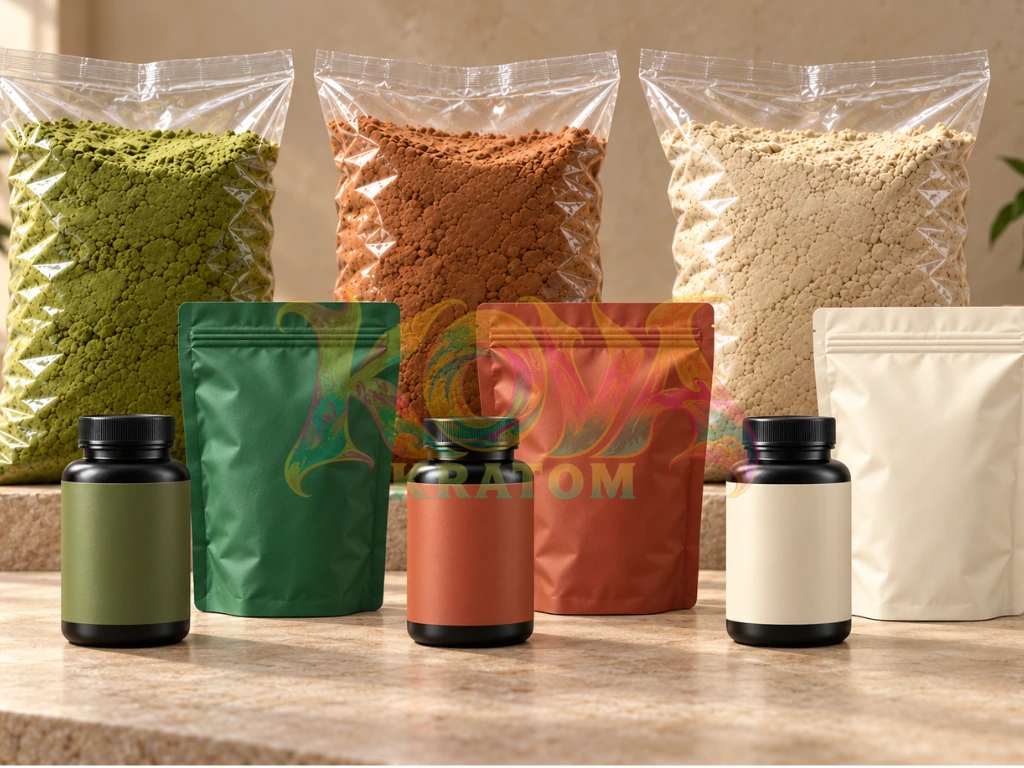
The right product format does more than determine how a product is packaged. It shapes how you manage inventory, serve customers, and plan your next order.
When sourcing kratom for a business, product selection is only part of the decision. The format in which you purchase it can be just as important.
Some buyers prefer bulk formats that offer flexibility for their own approved packaging and distribution processes. Others prefer retail-ready pouches that provide a branded presentation for their intended sales channels.
Neither option is automatically better. The right choice depends on your business model, operational capabilities, destination market, and purchasing requirements.
Here is how to evaluate the two formats before requesting a wholesale quotation.
What Is Bulk Kratom?
Bulk kratom refers to product supplied in larger-volume packaging rather than individual consumer-facing retail units.
For eligible businesses with appropriate facilities and authorization, bulk formats may suit distribution, further processing, or other permitted commercial applications.
The principal consideration is flexibility. Buyers can evaluate quantities and packaging arrangements according to their operational needs, subject to the product specifications and applicable requirements.
Before purchasing, clarify the net product weight, packaging materials, batch identification, available quality documentation, and any applicable minimum order quantity.
It is also important to establish what the quoted price includes. Product cost and packaging are not necessarily the same as the total cost of preparing goods for their intended market.
Bulk purchasing can be a practical option, but its suitability depends on what the buyer plans to do with the product after receiving it.
What Are Retail-Ready Pouches?
Retail-ready pouches are packaged units designed for presentation through an intended retail or distribution channel.
For businesses developing a branded product range, this format may simplify certain packaging and presentation decisions. It can also help establish a consistent visual identity across product listings and sales materials.
However, a finished pouch should not be assumed to satisfy every requirement in every market. Buyers must verify the labeling, packaging, product claims, and other applicable rules for their intended destination.
When evaluating retail-ready options, ask about the available net weights, packaging specifications, label information, minimum order quantities, and whether customization is available.
The practical question is not simply whether a pouch looks attractive. It is whether the finished format suits your business and the requirements of the market you intend to serve.
Bulk vs. Retail-Ready Pouches: The Key Differences
The following comparison highlights the main commercial considerations.
| Consideration | Bulk Format | Retail-Ready Pouches |
|---|---|---|
| Primary purpose | Larger-volume commercial supply | Packaged retail presentation |
| Packaging | Bulk packaging, subject to specification | Individual branded or retail-oriented units |
| Operational needs | May require additional authorized handling or packaging | Some packaging work may already be completed |
| Brand presentation | Depends on the buyer's downstream arrangements | Can provide a consistent product presentation |
| Cost evaluation | Include any subsequent processing and packaging costs | Include pouch, labeling, and applicable customization costs |
| Order planning | Evaluate quantity requirements and storage capacity | Evaluate unit count, net weight, and packaging MOQ |
| Best fit | Businesses with suitable bulk-handling arrangements | Businesses seeking a finished packaged format |
Actual specifications, prices, minimum order quantities, and included services vary by supplier and must be confirmed before ordering.
The Price Per Kilogram Is Only the Beginning
A lower quoted price does not necessarily mean a lower total operating cost.
For bulk orders, buyers may need to account for additional packaging, authorized processing, labeling, handling, and other costs associated with preparing the product for its intended use.
For pouch orders, the calculation may include the product, pouch materials, labels, packaging work, and any applicable customization charges.
A fair comparison begins by calculating the full expected cost of receiving and preparing the goods for the intended commercial channel.
For a packaged product, buyers should also consider the cost per saleable unit. The number of units, net weight per pouch, packaging requirements, and any expected losses or unusable units can affect the calculation.
Shipping, duties, taxes, and other import-related expenses should be included where applicable.
The objective is not to choose the format with the lowest headline price. It is to understand which option makes commercial sense after all relevant costs are considered.
Minimum Order Quantities Matter
Minimum order quantities can influence the decision just as much as unit pricing.
A bulk order may be quoted by weight, while a pouch order may have a minimum quantity expressed in individual units or total product weight.
These measurements are not interchangeable without checking the details.
For example, an order of 200 pouches containing 50 grams each represents 10 kilograms of net product. That calculation describes the quantity only; it does not establish the supplier's actual minimum order, availability, or price.
Before requesting a quotation, identify the quantity you need, the preferred packaging format, and whether you require customization.
A clear specification makes it easier to obtain a useful quotation and compare suppliers on an equivalent basis.
Consider Storage, Handling, and Inventory
Purchasing decisions do not end when the shipment arrives.
Bulk formats may require suitable storage, inventory controls, and additional authorized handling depending on the product and its intended use.
Retail-ready pouches may simplify unit-level inventory management, but buyers still need to consider storage conditions, packaging integrity, stock rotation, and destination-market requirements.
In either case, establish how products are identified, how batches are tracked, and what documentation accompanies the shipment.
These operational details are especially important for businesses that plan to reorder regularly or distribute products through multiple channels.
Which Format Should You Choose?
The decision becomes easier when you begin with your actual business requirements.
Consider bulk when:
- Your business has an appropriate and lawful use for bulk-format supply.
- You have suitable arrangements for storage, handling, and any subsequent authorized packaging.
- Your purchasing plan is based on larger-volume requirements.
- You have accounted for the additional costs and responsibilities involved.
Consider retail-ready pouches when:
- Your business needs individual packaged units.
- Consistent product presentation is important to your intended retail channel.
- You want to evaluate packaging specifications and branding options as part of the purchase.
- The proposed labeling and packaging can meet the requirements of your destination market.
These are general purchasing considerations, not guarantees of lower costs or higher profitability. The best format depends on the details of the transaction.
Questions to Ask Before Requesting a Quote
A well-prepared inquiry helps both buyer and supplier establish clear expectations.
Before requesting a wholesale quotation, consider providing:
- Destination market: The country where the product will be imported or sold.
- Preferred format: Bulk packaging or retail-ready pouches.
- Required quantity: Estimated total weight or number of units.
- Packaging specifications: Preferred net weight, materials, and any customization requirements.
- Documentation: The product specifications and quality or compliance documents you need to review.
- Shipping expectations: Preferred delivery arrangements and the allocation of shipping and import responsibilities.
The supplier should then be able to clarify which options are available, what the quotation includes, and which details require confirmation.
For international orders, the buyer and supplier should also verify the product's legal status and applicable requirements before committing to the transaction.
A Better Starting Point for Wholesale Sourcing
Bulk and retail-ready pouches serve different commercial needs. One is not inherently superior to the other.
Bulk formats may suit businesses with appropriate handling and packaging arrangements. Retail-ready pouches may suit businesses that prioritize finished product presentation. In both cases, the decision should be based on verified specifications, complete cost calculations, operational requirements, and applicable regulations.
At Kova Kratom, we welcome inquiries from qualified businesses interested in discussing available product formats, packaging specifications, order quantities, and potential wholesale arrangements.
Our aim is to make the initial conversation straightforward: understand the buyer's requirements, clarify the available options, and establish whether there is a suitable basis for working together.
A better wholesale decision begins with the right questionsâÂÂnot simply the lowest price.
Discuss Your Requirements With Kova
Are you evaluating bulk formats or retail-ready pouches for your business?
Contact Kova Kratom with your destination market, preferred format, estimated quantity, and packaging requirements. We can then discuss the options that may be suitable for your inquiry, subject to availability and applicable legal requirements.